Kathmandu.
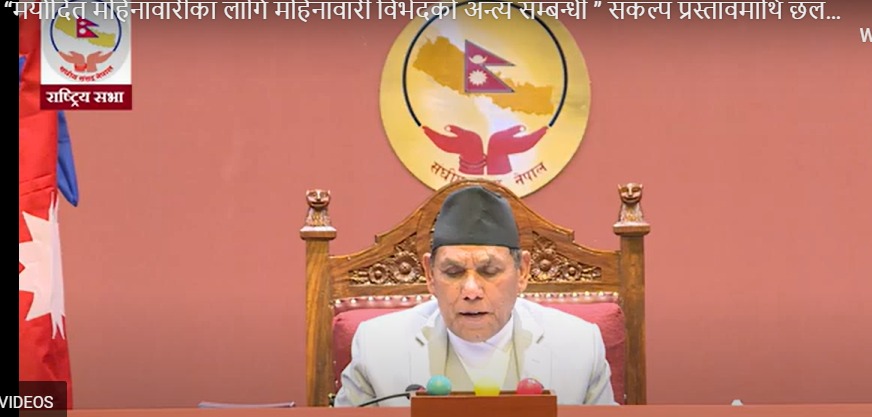
The dissolution of the House of Representatives has also thrown the National Assembly into uncertainty. With the government ending the Assembly’s session, lawmakers are trying to remain active through various parliamentary committees. However, they find themselves uncertain about what exactly to do next.
While both the Chairperson and members are keen to ensure the Upper House does not remain idle, lawmakers say it has become difficult to coordinate since only the government has the authority to convene a session. Amid this confusion, members have begun internal discussions to explore possible roles and ways to activate the Assembly during this transitional period.
A public hearing program titled “Search for the Land of the National Assembly” was held in collaboration with the Parliament Support Project, coordinated by the Parliament Secretariat, and organized by Nepal FM Network.
Amid the deadlock over “what should the National Assembly do after the House dissolution?”, a public hearing titled “The Role of the National Assembly Amid Political and Constitutional Uncertainty Following the Dissolution of the House of Representatives” was held in Kathmandu on Friday.
Speaking at the event, organized in collaboration with the Parliament Support Project, National Assembly member Bamdev Gautam said the Constitution does not grant the Upper House the power to take independent decisions. “The National Assembly cannot act alone,” he stated. “It plays a special role only during a state of emergency. Until elections are held, it is difficult to make major decisions. The nation is facing an unforeseen situation.”
Member Sumitra B.C. remarked that although the Constitution defines the Assembly’s role clearly, political deadlock has hindered its effective functioning. “We are trying to connect with the public through thematic committees,” she said, adding, “Even amid political polarization, the Assembly must find its constitutional space.”
Similarly, member Bishnu Bahadur Bishwakarma urged the President to call the next parliamentary session immediately after the Tihar festival. “Despite having a Constitution, the country should not feel stateless,” he said. “This is an extraordinary situation — the government must call the parliamentary session without delay.”
Member Krishna Adhikari highlighted the need for fair elections, cooperation among political parties, and a more proactive National Assembly. “As long as the Constitution exists, the National Assembly remains alive,” he said. “We can also convey a message of stability through a resolution motion.”
Former National Assembly Secretary Rajendra Phuyal explained that the very concept of the Upper House was introduced to ensure the country never remains without elected representatives. “Even when the House of Representatives is dissolved, the National Assembly retains its constitutional authority,” he said, suggesting this phase should be viewed as a “cooling-off period.”
Experts at the event expressed concern over the growing constitutional vacuum and lack of clear direction from the government. They emphasized that the National Assembly must safeguard democratic processes and lay the groundwork for political consensus during this period of instability.
Although the Assembly remains in limbo, members have initiated efforts to revive internal committee activities, accelerate internal dialogue, and define the institution’s role in the current context. Lawmakers indicated that further discussions on these matters are expected soon after Tihar.
Around 30 participants, including journalists, civil society representatives, and legal professionals, attended the event.